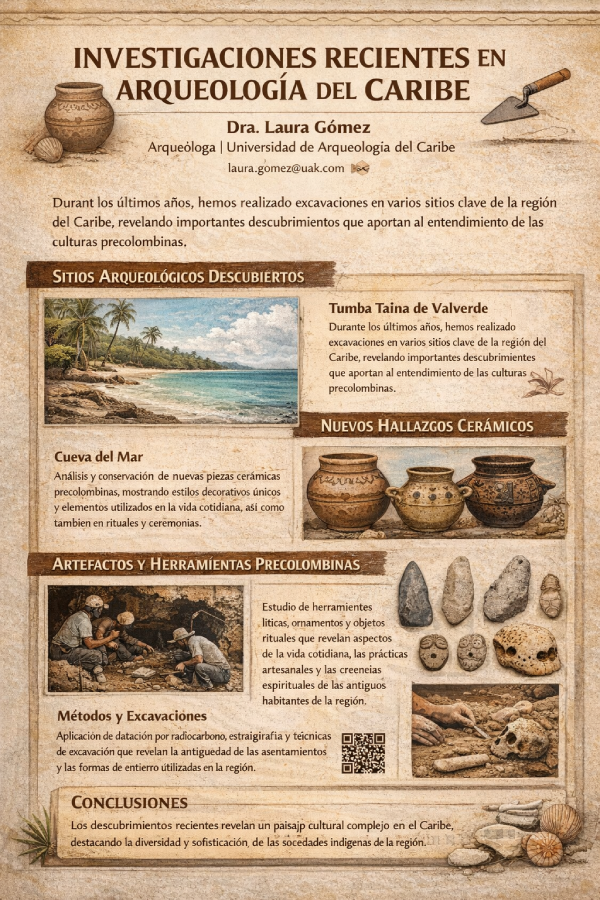

Your poster
The IACA Congress opens a space dedicated to the presentation of scientific posters, a dynamic format that allows the sharing of research, projects, and results in a visual and direct way.
Posters represent an excellent opportunity to disseminate ongoing or completed work, establish contact with other professionals, and foster academic exchange in a more approachable setting than traditional presentations.
We invite researchers, professionals, and students to participate by presenting their work related to Caribbean archaeology and related disciplines.
What can you present?
Posters are accepted on:
- Archaeological research (ongoing or completed)
- Field studies and excavations
- Material analysis (ceramics, lithics, bone remains, etc.)
- Cultural heritage and archaeological management
- New methodologies and applied technologies
- Interdisciplinary projects related to the Caribbean
Poster requirements
To ensure proper display, posters must meet the following conditions:
- Format: Vertical
- Recommended size: A0 (84 x 119 cm)
- Language: Spanish, English, or French
- Minimum content:
- Title of the work
- Author(s) name
- Institutional affiliation
- Introduction / context
- Methodology
- Results / findings
- Conclusions
- Visual quality: The use of images, graphs, and diagrams that facilitate understanding is recommended
- Readability: Clear typography and appropriate size for distance viewing
Participation process
Interested participants must send in advance a summary of their poster to info@congresoiacard2026.org for evaluation by the scientific committee. Once approved, they will be able to present their poster during the congress in the designated area.
Printing and setup
To facilitate participation, printing services will be available near the congress venue where you can:
- Print your poster in the required format
- Acquire supports or frames for proper vertical display
This allows participants to travel without needing to carry printed materials.
Interaction and networking
The poster area will be an active space within the congress, designed to encourage dialogue between authors and attendees. Participants are encouraged to be available during the assigned time slots to present their work and answer questions.
An example: